
Main guide: AI Horse Monitoring: How It Works, What It Can Detect, and Its Limits
Most guides to horse monitoring are written for a barn in Kentucky or Surrey: mild nights, fast broadband, one or two horses at home, and devices you order online and plug in. Stables in Egypt and the rest of the Middle East look different. Summers are long and hot, dust gets into everything, the power and internet can drop at night, many yards are large studs or clubs with dozens of stalls, and the people who look after the horses at night often speak Arabic first.
This guide walks through the horse monitoring options that exist today and how each one holds up in a stable in Cairo, Sharqia, Riyadh, Dubai or Doha, so you can choose something that will still be working in August.
What "horse monitoring" means
A horse monitoring system watches a horse when nobody is in the stable and tells you when something looks wrong. It does three things:
- Watches: a camera, or a sensor the horse wears.
- Notices: software that turns what it sees or measures into a warning, such as a horse rolling again and again, lying flat for too long, or not drinking.
- Alerts: a phone call, a notification or an alarm, so someone goes and checks.
Owners usually start looking after a bad night: a horse found cast in the morning, or colic that began after the evening check. The point of monitoring is to shorten the time between "something started" and "someone saw it". For how the AI part works, see AI horse monitoring: how it works and its limits.
The main options, and how they cope with local conditions
| Option | What it uses | Strengths | In a Middle East stable |
|---|---|---|---|
| A night guard or groom | People | Can act on the spot | Hard to stay alert all night; one person can't see every stall at once |
| CCTV you watch yourself | IP cameras and a phone app | Cheap, cameras widely sold locally | Nobody watches eight hours of footage; motion alerts fire all night because horses always move |
| Smart halter or body sensor | A device the horse wears | Can measure heart rate and breathing | Mostly imported; charging, fit and heat under a strap; often one horse per device and a monthly fee in foreign currency |
| Foaling alarm | A sensor fitted to a mare | Does one job well | Only useful around foaling |
| AI stable camera | Software reading a camera feed | Watches every stall at once, nothing on the horse, sends the clip | Needs a decent camera, steady power and an upload connection |
For a detailed side-by-side look at halters, sensors, foaling alarms and AI cameras, read colic alarms and horse monitors compared.
Heat, dust and wash-downs
Equipment that is fine in a European barn can fail in a Gulf summer. Before you buy anything for the stable, check:
- Operating temperature. Many consumer cameras are rated to about 40 °C. Stable roofs and walls in summer get hotter than that. Look for outdoor cameras rated to 50–60 °C, and mount them out of direct sun.
- Dust and water rating. Choose IP66 or IP67. Dust storms and daily hosing will kill a living-room camera in weeks.
- Anything worn by the horse sits on hot, sweaty skin. Ask the maker how it handles heat, and how often it needs charging and cleaning.
Our stable camera guide covers night vision, angle and mounting in detail.
Power and internet
Night is when monitoring matters most, and it is also when a stable's power or internet is most likely to drop unnoticed.
- Use a small UPS for the router and the camera switch (PoE), so a short power cut doesn't blind the system.
- Wired is best. Run Ethernet cable with power (PoE) to each camera where you can.
- 4G works for remote yards. Many farms outside the cities have no fixed line. A 4G router, or a camera with a SIM card, can carry the stream; check the signal inside the stable, not at the gate.
- Upload speed matters more than download. Cameras send video out. Ask your provider for the upload figure.
Cameras you can already buy locally
You don't need imported equipment to start. Hikvision, Dahua and Reolink IP cameras are sold widely across Egypt and the Gulf, and most of them provide an RTSP stream, the open video link that monitoring software reads. If your stable already has CCTV, it may be usable as it is. Our guide shows how to find your camera's RTSP link.
Cloud cameras made for homes, such as Ring, Arlo and Nest, usually don't share an RTSP stream, so software other than their own app can't watch them.
Large studs and clubs
Many Arabian horse studs and riding clubs in the region keep tens of horses under one roof. That changes what you need:
- Something that watches every stall at once. Per-horse wearables get expensive and hard to manage across thirty stalls.
- One screen for the whole night. The person on duty should see at a glance which horse needs them.
- Alerts that reach more than one person, such as the manager, the night groom and the owner, so a warning isn't lost on one phone.
- Clear rules for staff cameras. Tell grooms where cameras are and why, limit who can see footage, and decide how long it is kept.
Arabic, and who answers the alert
An alert only helps if the person who gets it understands it and knows what to do. Ask whether the app and alerts work in Arabic, whether support answers in Arabic, and whether the alert shows the moment on video, so a groom can check the clip and call the manager or the vet without guessing.
Questions to ask before you choose
- Does it work with the cameras I already have, or must I buy new ones?
- Will it run through a power or internet cut, and will it tell me when a camera goes offline?
- What exactly does it alert on, and does each alert come with the video clip?
- Can several people get the alerts, in Arabic?
- Who can see the footage, and how long is it kept?
- Is it priced per horse or per stable, and in which currency?
- Does the company have people in the region who can help set it up?
How HCS fits in
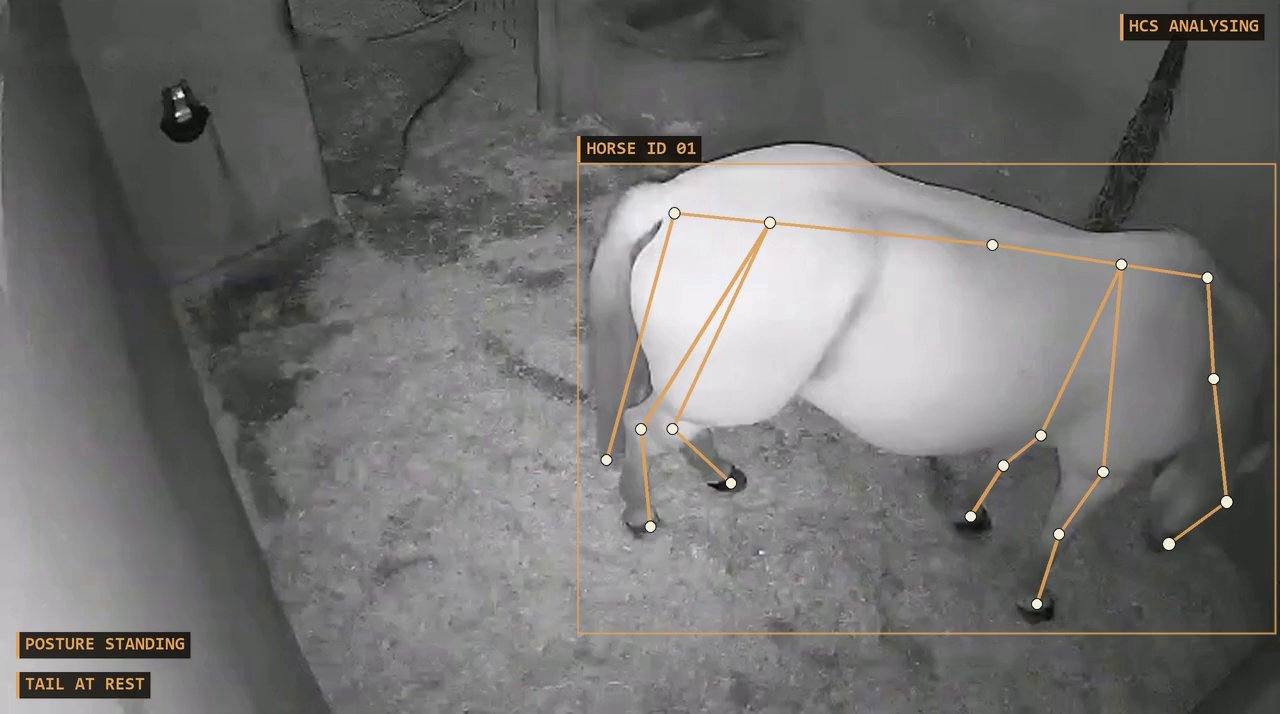
We built HCS (Horse Care Solutions) in Cairo for exactly these stables. HCS connects to the IP cameras you already have through their RTSP link, watches every stall at once, and alerts you in the HCS Watch app, in Arabic or English, with the clip that shows why. It focuses on behaviour linked to colic and distress, such as repeated rolling, pawing and going down again and again, and gives you a daily report of how each horse ate, drank, rested and moved. HCS is a monitoring aid, not a diagnosis: when it alerts, you or your vet decide what to do.
HCS Watch is available to order in Egypt, Saudi Arabia, the UAE and the rest of the Gulf, from $25 per camera per month. If you run a yard, stud or club, ask us for a live demo.