
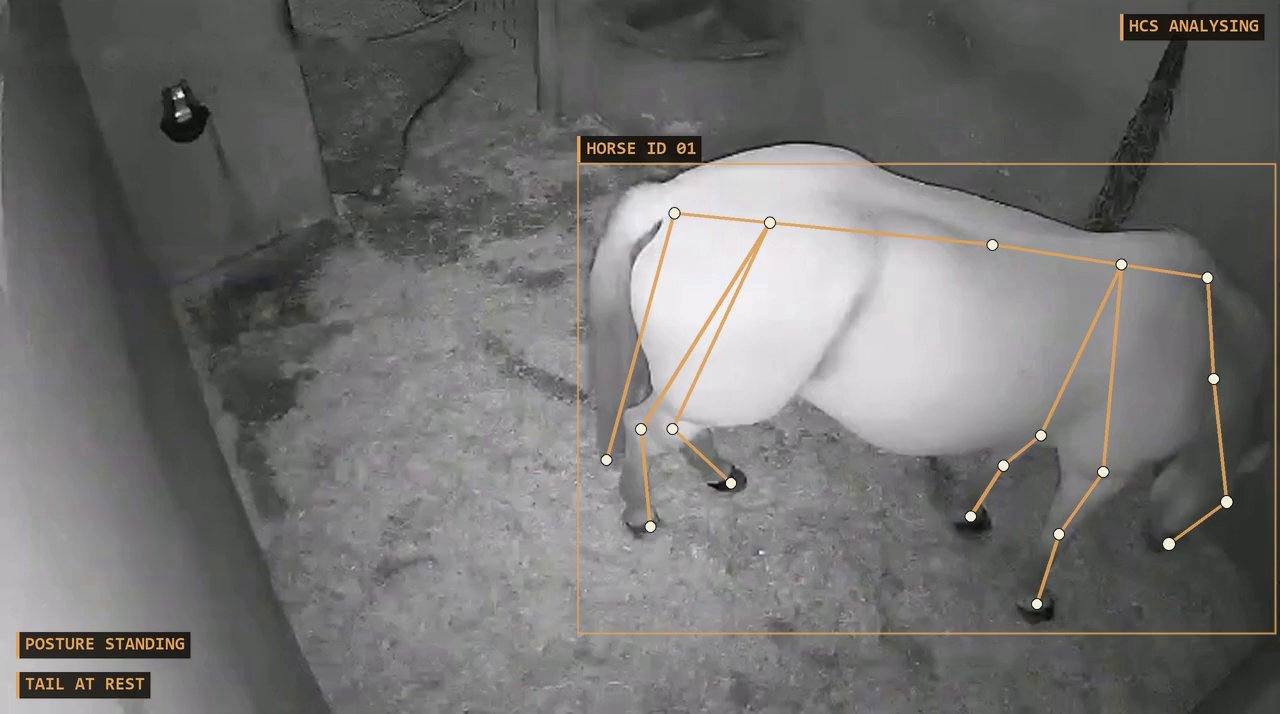
Most of what goes wrong with a stabled horse happens when nobody is there: in the night, between the last check and the morning feed. A camera in the stall lets you look in from your phone, but nobody can watch a live feed for ten hours.
AI horse monitoring closes that gap. Software watches the stall camera for you, learns what your horse is doing minute by minute, and tells you when something looks wrong. This guide explains how it works, what it can and can't notice, what the research says so far, and what to ask before you choose a system.
What AI horse monitoring is
An AI monitoring system is software connected to a camera that points at your horse. Instead of recording video for someone to scroll through later, it reads the picture as it arrives and turns it into a running account of the night:
- where the horse is in the stall
- whether it is standing, lying on its chest, or lying flat on its side
- what it is doing: eating, drinking, resting, moving, rolling, pawing
- who came into the stall, and when
It then compares that account with what is normal for that horse, and sends an alert when something important happens or keeps happening. The best systems send the alert with the video clip that triggered it, so you can see for yourself in a few seconds.
It is not a vet, and it doesn't diagnose anything. Its job is to make sure you hear about a problem at 2 a.m. instead of at 7 a.m.
How a camera "sees" a horse
Behind the scenes, most camera systems work in four steps.
- Find the horse. A detection model, trained on thousands of stable images, draws a box around each horse in the picture, by day and in infrared at night.
- Track its body. A pose model places points on the horse's body (head, withers, hips, legs, hooves) and follows them from frame to frame. This is what lets the system tell a horse lying on its chest from one lying flat, or a horse turning its head towards its flank.
- Name the behaviour. A third step looks at how those points move over a few seconds and labels the behaviour: standing, lying down, getting up, rolling, pawing, drinking.
- Look for patterns over time. One roll after fresh bedding is normal. Rolling again and again, going down and getting up repeatedly, or lying flat far longer than usual is not. The system raises an alert on the pattern, not on a single moment.
That last step is what separates a monitoring system from a motion alarm. A motion alarm tells you the horse moved, which a horse does all night. A behaviour model tells you how it moved, and whether that matters.
What it can watch for
| What the camera notices | Why an owner cares |
|---|---|
| Repeated rolling, pawing, going down and getting up | These are among the classic behaviour signs of colic |
| Lying flat for an unusually long time, or struggling to rise | Can mean pain, exhaustion, or a horse that is cast against the wall |
| Not going to the water or the feed | Changes in drinking and eating are often the earliest sign that something is off |
| Total rest and activity through the night | A horse that hasn't lain down for days may be sleep-deprived; one that is restless may be uncomfortable |
| A person entering the stall | Security, and a record of when the groom fed, mucked out or checked |
| The horse missing from its stall | A loose horse, or a horse that has gone out and not come back |
None of these needs anything attached to the horse. The camera you mount once does all of it.
What the research says so far
Watching animals with computer vision is a young field, but the results are encouraging, and also honest about the limits.
- Standing and lying can be told apart reliably. A 2026 study in Veterinary Quarterly trained a deep learning model on 29 days of continuous video of a stabled horse. On its test set, standing was detected with 97.5% precision and 89.2% recall, and lying with 92.8% precision but only 63.1% recall: when the model said "lying" it was usually right, but it missed some lying periods. The same work also picked out drinking and showed when the horse tended to drink.
- Faces carry information about pain and emotion. Researchers have trained models to read horses' faces against the Horse Grimace Scale, a pain scale vets use. In a 2021 PLOS ONE study of horses after castration, the system separated "pain" from "no pain" with 88.3% accuracy. A 2024 study reached 76% accuracy in telling four emotional states apart from video.
- Sensors on the body work too. A 2024 Belgian study fitted mares with accelerometer leg boots and detected induced colic with 91.2% accuracy compared with vets' assessments.
The common thread, in the words of a 2025 editorial in Frontiers in Veterinary Science: these technologies "have demonstrated high potential in research settings", but "many have yet to transition successfully into practical, everyday applications". Most studies involve a handful of horses, filmed in good conditions. Real stables are darker, dustier and more varied, which is why a system's performance in your stall matters more than a headline number.
What it can't do
Being clear about limits is part of using any monitor well.
- It can't diagnose. It can tell you your horse has rolled six times in twenty minutes. It can't tell you why. That is your vet's job.
- It only sees what the camera sees. A blind corner, a camera that shows only the door, or a lens covered in dust leaves gaps. Placement matters more than resolution (our guide to choosing a stable camera covers this).
- It doesn't measure vital signs. A camera can't take a temperature or count a heart rate the way a sensor on the body can.
- It will sometimes be wrong. Every alarm system trades missed events against false alarms. A good one lets you see the clip, so a false alarm costs you ten seconds rather than a trip to the yard.
Camera or wearable?
The other main approach is a sensor worn by the horse: a smart halter, a surcingle or a leg band that measures movement and sometimes heart rate and breathing. The two approaches are complementary rather than rivals.
- Cameras need nothing on the horse, cover a whole stall or a whole barn, can use cameras you already own, and show you the evidence. They can't measure physiology, and they only work where there is a camera.
- Wearables measure the body directly and go wherever the horse goes. They must be fitted, charged, cleaned and kept on, and the horse must tolerate them.
Questions to ask before you choose a system
- Does it work with cameras I already have? Many systems can read any IP camera that offers an RTSP stream. If yours do, you may not need new hardware (how to find your camera's RTSP link).
- Does it work at night? Ask to see real infrared footage from a stable, not daylight demos.
- What exactly triggers an alert? Single events, or patterns over time? Can you adjust it for a horse that rolls every evening?
- Do alerts come with the clip? An alert you can check in seconds is one you will trust.
- How does it reach me? Push notification, call, WhatsApp? Will it wake you up?
- Who can see my footage, and where is it kept? Your stable cameras show your property and your staff. Ask how the video is secured and whether your cameras are exposed to the internet.
- What does it know about my horse? Systems that learn each horse's normal (how long it usually lies down, when it usually drinks) give fewer false alarms than ones with fixed rules.
How HCS does it
HCS is an AI monitoring system built this way. It connects to your stable cameras, follows each horse's posture and movement day and night, and alerts you on your phone, with the clip, when a pattern such as repeated rolling or going down and getting up again keeps going. During the day it keeps a record of rest, drinking, feeding and who visited the stall, so you know your horse's normal before anything goes wrong.
HCS is a monitoring aid, not a diagnosis. It gives you an earlier reason to go and look, and to call your vet sooner. If you'd like to see it on your own cameras, get in touch. Choosing for a stable in Egypt or the Gulf? Read our guide to horse monitoring systems in Egypt and the Middle East.
Sources
- Giannone C, Maccario C, Dalla Costa E, Atallah E, Bovo M., Monitoring horse behaviour with deep learning models, Veterinary Quarterly 2026;46(1):2665442
- Lencioni GC et al., Pain assessment in horses using automatic facial expression recognition through deep learning-based modeling, PLOS ONE 2021;16(10):e0258672
- Feighelstein M et al., Automated recognition of emotional states of horses from facial expressions, PLOS ONE 2024;19(7):e0302893
- Equus, Wearable colic detector shows promise, on Eerdekens et al., Equine Veterinary Journal 2024
- Dalla Costa E, Bovo M., Editorial: Advances in the application of technology for monitoring horse welfare and health, Frontiers in Veterinary Science 2025;12:1715133